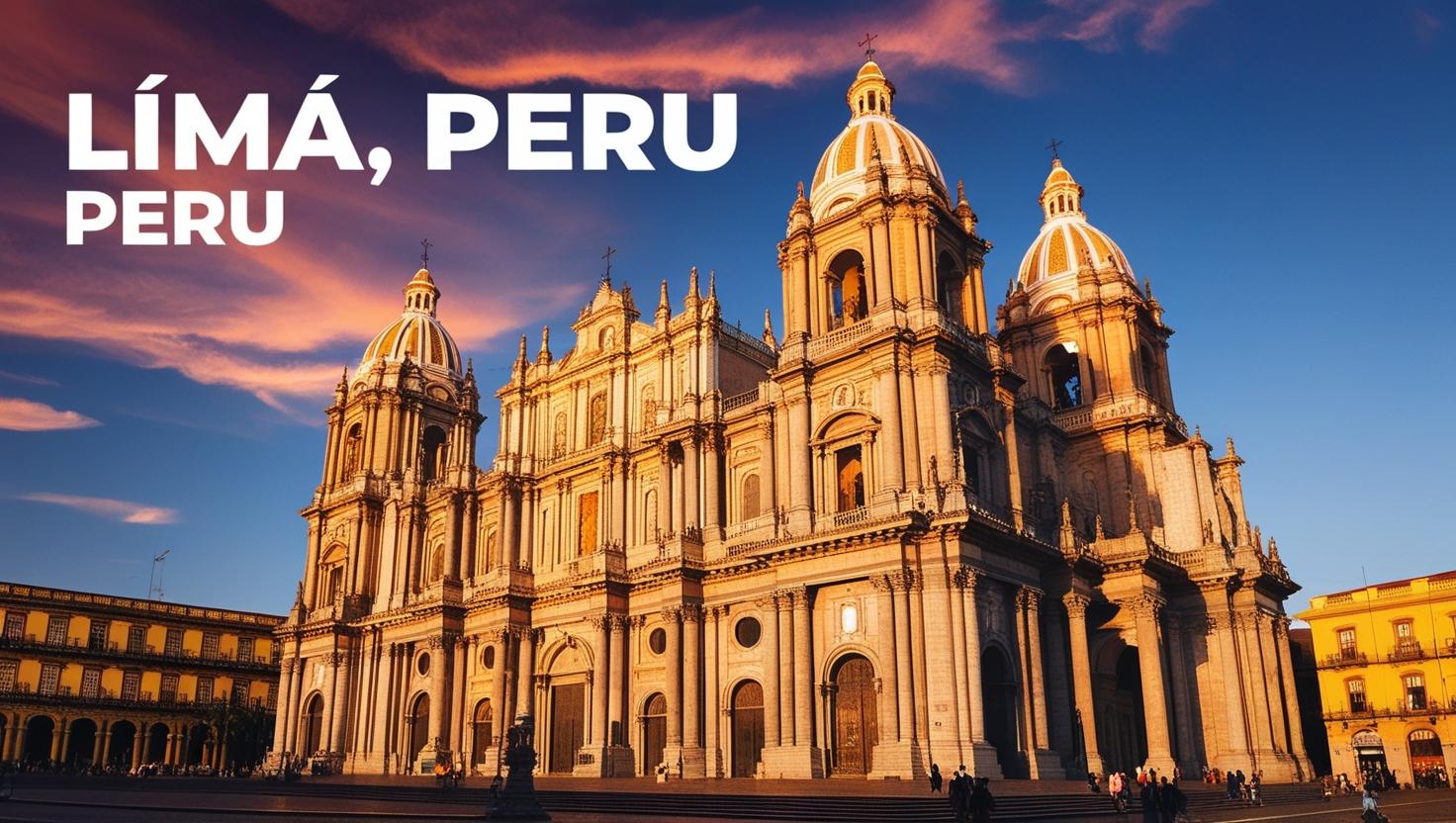
Lima Cathedral on the Plaza Mayor is an imposing 16th-century colonial Baroque temple, a National Historic Monument that holds the remains of Francisco Pizarro.
Lima Cathedral is undoubtedly one of the most emblematic and fascinating landmarks in the Peruvian capital. Its impressive colonial Baroque architecture reflects not only the historical richness of Peru but also offers a deep connection to the country’s faith and culture. It stands on the eastern side of Lima’s Plaza Mayor, directly facing the Government Palace.
It was declared a National Historic Monument and is considered one of the most important colonial cathedrals in South America. Its history spanning more than 480 years is marked by ambition, devotion, and the ability to rise again in the face of natural disasters.
History: A Cathedral Built Five Times
Lima Cathedral has a history marked by perseverance. The first church on this site was a modest chapel built in 1535, just a year after Lima was founded by Francisco Pizarro. According to tradition, Pizarro himself laid the first stone.
However, Lima is located in one of the most seismically active zones in the world, and earthquakes have repeatedly destroyed and forced the reconstruction of the cathedral. The current church is the fifth version of the building, completed in its present configuration in 1758, though it underwent major restoration following the earthquake of 1746.
In each reconstruction, the cathedral was adapted to the prevailing architectural style of the time, which explains why the current building combines elements of the Renaissance, Baroque, and Neoclassical in a synthesis characteristic of Lima’s colonial art.
The Façade and Exterior
The façade of Lima Cathedral is one of the finest examples of Lima Baroque, a style that blends the formal vocabulary of Spanish Baroque with characteristics unique to Peruvian colonial art. The two lateral towers frame a central portal of great ornamental richness, featuring Solomonic columns, niched sculptures of saints, and a broken-arch pediment typical of the Baroque style.
The façade is built in white sillar from Pachacamac — a local volcanic stone of pale color — that gives the cathedral its characteristic white tonality, which is lit spectacularly at night.
The Interior: Colonial Art at Its Finest
The interior of the cathedral impresses with the richness and variety of its artistic heritage. Three naves separated by marble columns with gilded capitals create a deep and solemn perspective.
The side chapels: the cathedral has 14 side chapels, each dedicated to a different saint or Marian devotion. The first chapel on the right of the entrance is especially important: it holds the remains of Francisco Pizarro, the conquistador who founded Lima. His marble sarcophagus and the bones on display in a glass case are among the most visited points in the cathedral.
The choir stalls: this impressive 17th-century carved wooden ensemble is a masterpiece of colonial craftsmanship. The backs of the 45 stalls are carved with figures of saints, doctors of the Church, and botanical motifs with an extraordinary level of detail.
The High Altarpiece: built in the 17th century and subsequently restored, the main altarpiece is dedicated to the Assumption of the Virgin Mary and combines marble columns with gilded carvings and polychrome sculptures.
The Altar of the Forgiven: a chapel particularly venerated by Lima’s faithful, where an image of the Cristo de los Milagros is kept — a replica of the famous Cristo Morado of Pachacamilla.
The Religious Art Museum
Within the cathedral, a Religious Art Museum exhibits collections of priceless pieces. The collection includes:
- Colonial silverwork: chalices, monstrances, and liturgical objects crafted in silver and gold by Peruvian master artisans of the 17th and 18th centuries.
- Lima and Cusco school paintings: large canvases depicting biblical scenes in the characteristic style of Andean Baroque.
- Liturgical textiles: chasubles, pluvials, and dalmaticas embroidered with gold and silver thread.
- Colonial sculpture: processional images, crucifixes, and representations of saints of extraordinary artistic quality.
Practical Tips for Your Visit
-
Location and access: the cathedral is on the Plaza Mayor, a central and easily accessible location. It is well served by public transport and features on all historic center walking tours.
-
Dress code: this is an active place of worship. Respectful attire is recommended, covering shoulders and knees.
-
Photography: photography is permitted in most of the interior, but should be done discreetly and respectfully, especially during masses.
-
Evening visit: the cathedral illuminated at night, seen from the Plaza Mayor, is one of Lima’s most beautiful sights. Weekend evening masses are a memorable cultural and spiritual experience.
-
Guided tours: exploring with a guide is recommended to fully appreciate the historical and artistic richness of the site.
Hours
- Depends on the type of visit and tour operator
- It is recommended to check directly at the site or with local agencies
Admission Price
- Varies by operator and tour type
- It is recommended to verify current prices before visiting