
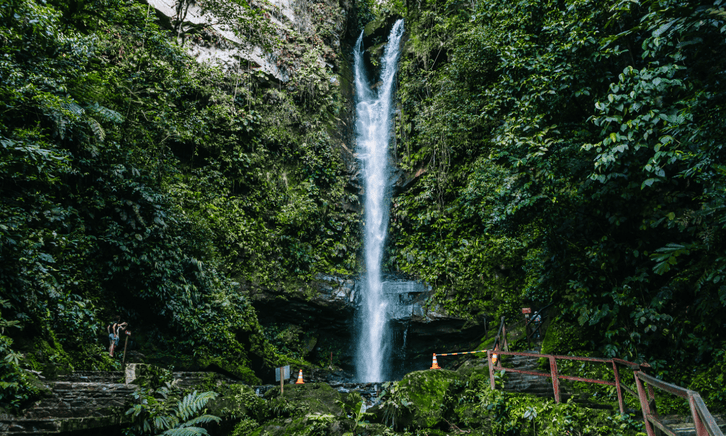
Ahuashiyacu Waterfalls near Tarapoto in San Martín drop up to 350 meters through a protected cloud forest reserve. Complete visitor guide with routes and tips.
Just fourteen kilometers from Tarapoto, on the eastern slopes of the Cordillera Escalera, the sound reaches you before the sight does — a low, sustained rumble that grows louder with each step along the forest trail. That sound is the Ahuashiyacu Waterfalls, a two-cascade system tucked within the cloud forests of Peru’s San Martín region. The name comes from Quechua: ahuashi (to sing) combined with yacu (water). It is a name that works as a promise, and the waterfalls deliver on it fully. Few places in the Peruvian Amazon are this spectacular and this easy to reach.
The Ahuashiyacu Waterfalls are located within the Área de Conservación Regional Cordillera Escalera (ACR-CE), a protected reserve covering more than 149,000 hectares, established in 2005 to preserve the montane rainforests that supply drinking water to Tarapoto and the surrounding valleys. In 2024, the site welcomed over 177,000 visitors — more than 11,500 of them international travelers — making it the most-visited natural attraction in all of San Martín. On January 13, 2021, Municipal Resolution N° 016-2021-MDBSH formally recognized the Ahuashiyacu Waterfalls as an official Tourist Attraction of La Banda de Shilcayo district, though travelers had long since made that assessment themselves.
For those seeking to experience Peru’s cloud forest ecology without a multi-day wilderness expedition, the Ahuashiyacu Waterfalls offer one of the country’s most compelling half-day excursions: a 15-minute forest trail, a 40-meter cascade, a clear natural swimming pool, and a supporting cast of rare birds and electric-blue butterflies.
History of the Ahuashiyacu Waterfalls
The story of the Ahuashiyacu Waterfalls begins long before the arrival of formal conservation. The Cordillera Escalera was home to Quechua-speaking communities who built their lives among these rivers and ridges, navigating the terrain between the highlands and the lowland river systems of the Amazon basin. For these peoples, the waterfalls were not a destination but a constant — a reliable sound in the forest, a source of cold water in the heat of the dry season, a feature of the landscape as familiar as the hills themselves. The name they gave it, ahuashiyacu, the singing water, reflects a way of relating to the natural world that went beyond utility.
When Spanish colonizers reached San Martín in the sixteenth century, the region became a contested frontier between Andean and Amazonian worlds. The slopes of the Cordillera Escalera served as a transit corridor for missionaries, traders, and later, during the rubber boom of the late nineteenth century, the agents of an extractive economy that transformed the entire Amazon region. It is very likely that the waterfalls functioned as a waypoint on those journeys — a place to drink, rest, and shelter from afternoon rains before pressing on toward Yurimaguas or back toward the highlands.
By the mid-twentieth century, Tarapoto had grown into a regional hub, and the surrounding countryside began attracting day visitors from the city seeking relief from the heat in the cool pool at the base of the falls. What had been a remote forest feature became an informal local gathering place, and eventually, as tourism in San Martín developed, the main attraction of the region.
The formal conservation of the Cordillera Escalera in 2005 changed the management context significantly. The Autoridad Regional Ambiental de San Martín (ARA-SM) took over stewardship of the waterfall site in 2012, installing wooden bridges, changing facilities, lifeguards, waste receptacles, and informational signage throughout the access trail. That investment turned a popular swimming hole into a properly managed ecotourism site — and visitor numbers climbed steadily in response.
Where a 350-Meter Drop Meets a Swimming Hole
The Ahuashiyacu Waterfalls are actually two very different cascades, and understanding both is key to planning a visit.
The first, known as the Catarata de las Golondrinas (Swallow Waterfall), stands at 1,500 meters above sea level and plunges 350 meters over a sheer rock face. It is the dramatic, untouchable waterfall of the two — no trail leads to its base, and access on foot is not possible. Instead, it is viewed from the Alto Ahuashiyacu overlook near kilometer 13 of the highway toward Yurimaguas. From there, a white column of water slices through an unbroken wall of green forest, dissolving into mist and cloud far below. The scale is difficult to process at first; standing at the viewpoint, the waterfall looks small until you register the size of the trees beside it and recalibrate your sense of distance.
The second waterfall is the one most visitors come for: the main Ahuashiyacu cascade, which drops 40 meters into a natural pool measuring 430 square meters with a depth of roughly 3 meters. The water is extraordinarily clear — calm conditions reveal the rocky bottom in full detail despite the depth — and cold enough to feel genuinely refreshing after the forest walk. Swimming is permitted, and a lifeguard is stationed at the pool during operating hours. The combination of a dramatic cascade, transparent water, and the surrounding forest canopy makes the pool one of the most photogenic natural spots in the Peruvian selva alta.
Getting to the main cascade involves a 15-minute walk through dense cloud forest on a well-maintained trail. The ecosystem along this short path rewards attention. Massive pona palms (Socratea), ana caspi trees (Apoleia leiocorpa), and renaco (Coussapoa) tower overhead while a ground layer of ferns, mosses, and bromeliads covers every surface. Where sunlight breaks through the canopy, Morpho Elena butterflies flash iridescent blue wings that seem almost too vivid to be real. The birdlife is equally striking: the gallito de las rocas (Rupícola peruviana), Peru’s national bird, is regularly spotted along the trail, while hummingbirds dart between flowering plants and the semi-yellow toucanet (Aulacorhynchus huallagae) — a species endemic to this corner of the Andes — calls from the mid-canopy. For birdwatchers, a 15-minute walk becomes a genuinely productive session.
Highlights of the Ahuashiyacu Waterfalls
-
The main cascade and swimming pool: The 40-meter waterfall feeds a crystalline pool ideal for swimming and underwater photography. Water temperature stays cool year-round, and lifeguard supervision provides a safety margin for families with children. The pool walls reflect the surrounding vegetation, making the site visually striking even without entering the water.
-
Alto Ahuashiyacu Overlook: Positioned near km 13 of the Yurimaguas highway, this roadside viewpoint offers the only accessible sightline to the Catarata de las Golondrinas. No hiking is required — the view is available from the parking area itself, and it is one of the most dramatic natural panoramas in San Martín.
-
Cloud forest trail: The 15-minute access path through the conservation area is an immersive experience in its own right. Dense vegetation, native tree species identified by trail signs, and the layered soundtrack of the forest — birdsong over the distant roar of the falls — make the walk rewarding independent of the destination.
-
Birdwatching corridor: The transition zone between cloud forest and the open waterfall clearing concentrates wildlife activity in a small geographic area. The gallito de las rocas with its vivid orange-red plumage is the signature sighting, but the trail regularly produces hummingbirds, swallows, and various canopy species.
-
Local food and craft market: Near the park entrance, vendors offer regional artisan goods and simple Amazonian dishes — juanes (rice tamales wrapped in bijao leaves), grilled river fish, tacacho, and cold drinks made from local tropical fruits. This is a worthwhile stop for travelers interested in San Martín’s food culture before or after the hike.
Tips for Visiting the Ahuashiyacu Waterfalls
- Best season: June through November offers dry-season conditions — firm trails, clearer skies, and optimal swimming. December through May brings heavy rainfall that can make the path slippery and dramatically increase the waterfall’s volume, which is visually impressive but may restrict pool access.
- Arrive at opening time: The park opens at 9:00 a.m. Early arrival means fewer visitors, better morning light for photography, and a higher chance of wildlife sightings before midday heat quiets the forest.
- What to wear: Lightweight, quick-dry clothing handles the humid climate well. Bring a dry change of clothes if you plan to swim. Trail shoes or grippy hiking sandals are sufficient in dry season; waterproof boots are advisable after rain.
- Sun and insect protection: Cloud forest altitude doesn’t eliminate UV exposure, and forest clearings can be surprisingly bright. Apply both sunscreen and insect repellent before entering the trail.
- Carry cash: The S/ 10.00 entrance fee is collected at the highway checkpoint and card payment may not be available. Bring small bills.
- Respect the reserve: The ACR Cordillera Escalera is an active conservation area, not a theme park. Do not pick plants, feed wildlife, or leave waste anywhere but the provided rubbish bins. The forest ecosystems here are ecologically sensitive and slow to recover from disturbance.
- Photography: The strongest angle for the main cascade is from the left bank of the pool, where morning light strikes the waterfall face directly. For the Golondrinas overlook, late afternoon light creates better contrast and shadow definition on the rock face.
How to Get to the Ahuashiyacu Waterfalls
Lima – Tarapoto
The fastest route from Lima is by air: direct flights from Jorge Chávez International Airport to Tarapoto’s Cadete FAP Guillermo del Castillo Paredes Airport take approximately one and a half to two hours. Multiple national carriers operate daily services.
By land, the journey takes between 20 and 24 hours. Bus companies including Móvil Tours and Turismo Días operate overnight services from Lima’s Javier Prado and Plaza Norte terminals, traveling through the central jungle via Tingo María and Juanjuí before reaching Tarapoto. The road passes through some of Peru’s most dramatic highland and jungle scenery, though the journey length makes the flight a more practical choice for most international visitors.
Tarapoto – Ahuashiyacu Waterfalls
The waterfalls are 14 kilometers from Tarapoto’s center along the paved highway toward Yurimaguas — a well-maintained road in good condition year-round. Three transport options are available:
- Shared van: Take a mototaxi from the Plaza de Armas to the La Banda de Shilcayo terminal on Avenida Alfonso Ugarte (S/ 3–5), then board a colectivo van that drops you at the park entrance for S/ 14 per person. Total cost: approximately S/ 19 each way.
- Organized tour: Half-day tours from Tarapoto run from S/ 45 to S/ 60 per person and include hotel pickup, a Spanish-speaking guide, and entrance fees. Bookings are available through local agencies and platforms like GetYourGuide.
- Private taxi or rental car: The drive takes 25 to 40 minutes on paved road. Parking is available at the site entrance at no additional cost.
Frequently Asked Questions about the Ahuashiyacu Waterfalls
How much time do you need to visit the Ahuashiyacu Waterfalls?
A comfortable visit including round-trip transport from Tarapoto, the forest walk, time at the pool, and a stop at the overlook takes three to four hours in total. If you are visiting independently and walking only to the main waterfall without lingering, allow at least two hours including transit. Organized half-day tours typically allocate three to three and a half hours on-site.
Can you visit the Ahuashiyacu Waterfalls year-round?
Yes. The park operates 365 days a year, but conditions vary significantly by season. June through November (dry season) offers the best trail conditions and swimming. December through May brings heavy precipitation that can make the path muddy, temporarily close sections of the trail, and increase the waterfall’s flow to a level that limits safe pool access, though the visual impact of the cascade at full volume is considerable.
How much does entry to the Ahuashiyacu Waterfalls cost?
General admission is S/ 10.00 per person. Residents of La Banda de Shilcayo district pay a reduced rate of S/ 6.00. Children’s rates may differ; confirm at the ticket booth on arrival. All prices are approximate and subject to change.
How difficult is it to reach the Ahuashiyacu Waterfalls?
The trail to the main waterfall is low to moderate difficulty: approximately 15 minutes of walking on a well-maintained path with wooden bridges over stream crossings. It suits most fitness levels, including children over six years old, and requires no specialist equipment or prior hiking experience. The Catarata de las Golondrinas (the 350-meter upper waterfall) cannot be accessed on foot and is only visible from the roadside overlook near km 13.
Are there tourist services near the Ahuashiyacu Waterfalls?
Food stalls, artisan vendors, and a parking area are available at the park entrance. Changing rooms and lifeguard services operate at the pool during open hours. Tarapoto, 14 kilometers away, provides a full range of accommodation (hostels to three-star hotels), restaurants, travel agencies, ATMs, pharmacies, and medical facilities.
Opening Hours
- 9:00 a.m. – 4:00 p.m., every day
- Approximate
Entrance Fee
- S/ 10.00 per person (general admission)
- S/ 6.00 for residents of La Banda de Shilcayo district
- Approximate