Considered one of the first religious monuments of the 17th century, built with volcanic rock and brick vaults.
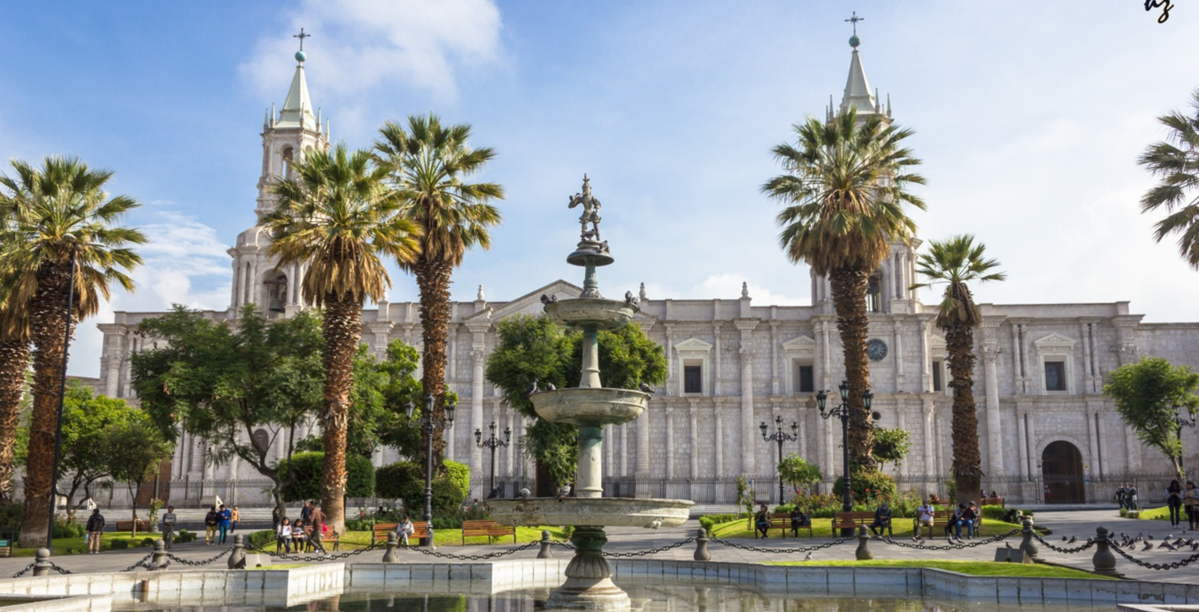
The Arequipa Cathedral Basilica is one of the most important religious monuments of the 17th century, built with volcanic rock and brick vaults. It occupies the entire northern side of the Plaza de Armas and dominates the city’s skyline with its twin towers rising to 44 meters in height.
It is considered one of the most imposing colonial cathedrals in South America and was declared a UNESCO World Heritage Site together with the entire historic center of Arequipa in the year 2000.
History: A Cathedral Built and Rebuilt
The history of Arequipa Cathedral is a story of resilience. The original church was built in 1615 on the site where the city’s earliest masses were held following its foundation. Decades later, a Baroque-style cathedral was completed in 1656.
However, Arequipa is a city that coexists with volcanic activity and earthquakes. A fire in 1844 almost completely destroyed the earlier cathedral, necessitating the construction of the current neoclassical structure. The design was entrusted to architect Lucas Poblete, who created a monumental façade with 70 classical columns arranged symmetrically.
On September 19, 1940, Pope Pius XII elevated the Cathedral to the dignity of Minor Basilica, the highest title a Catholic church can receive. In 2001 a new earthquake seriously damaged one of the towers, which was subsequently rebuilt with great fidelity to the original design.
The Façade: White Sillar and Columns
The first thing that strikes visitors is the façade. Built entirely in white sillar — the volcanic rock characteristic of Arequipa — the façade stretches the entire length of the northern block of the Plaza de Armas. The 70 composite-order columns that adorn it create a visual rhythm reminiscent of the great Roman temples.
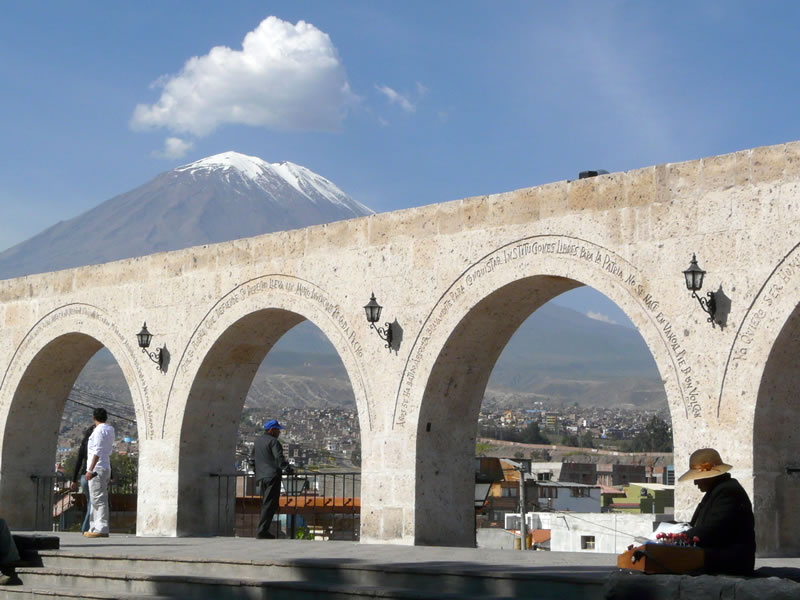
The two lateral towers, built at different periods, flank the central façade. The southern tower houses one of the largest bells in South America, brought from France in the 19th century. On clear days, the white of the sillar contrasts dramatically with the Misti volcano in the background, creating one of the most photographed views in Peru.
The Interior: Art and Devotion
The interior of the cathedral impresses with its spaciousness and the quality of its artistic heritage. Three naves separated by marble columns create a solemn atmosphere. Among the most notable elements:
- The pipe organ: brought from Belgium in the 19th century, it is one of the largest in South America with more than 4,000 pipes. Its occasional concerts are highly valued cultural events in Arequipa.
- The cedar choir stalls: a masterpiece of 19th-century Arequipa woodworking with detailed carvings of saints and floral motifs.
- The main altarpiece: built in Carrara marble with Solomonic columns and figures of angels and saints.
- The side chapels: each dedicated to a different saint, they contain paintings, sculptures, and silverwork from the 17th to 19th centuries, many of them from the Cusco school.
- The remains of Francisco Javier de Luna Pizarro: the first Archbishop of Lima and a key figure in Peru’s independence is buried in the cathedral.
The Religious Art Museum
Within the cathedral complex, a Religious Art Museum exhibits collections of silverwork, liturgical textiles, paintings, and sculptures from the 17th to 20th centuries. The collection includes repoussé silver chalices, chasubles embroidered with gold and silver thread, and Cusco school paintings depicting Old and New Testament scenes in a unique mestizo style.
Museum admission is included with the cathedral entrance fee and the visit takes approximately one hour.
Hours
- 10:00 AM to 5:00 PM
- Approximate schedule
Admission Price
- S/10.00 soles
- Approximate price